
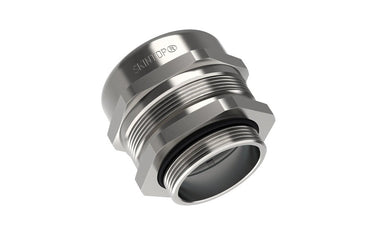
A gland's IP rating can look fine on paper right up until salt air or UV cracks the seal it depends on. Check UV resistance in the polymer body and corrosion resistance in the metal components at coastal or high-UV sites, and for the internal condensation that heat cycling drives, add a pressure-compensation element, since a sealing gland cannot vent it. For shielded communication cable entries, also confirm shield continuity, or the EMI problem the cable was specified to prevent can reopen at the entry point.
This piece closes July's renewable energy series with the part every connector, harness and communication cable in the month depends on: the entry point into the enclosure. A solar inverter or combiner box enclosure, and a wind turbine junction box or nacelle entry, are each only as sealed as their cable entries, and many of the connectors, harnesses and communication cables covered in the first three weeks of this series reach the enclosure through a SKINTOP® gland.
This is written for EPC contractors and enclosure integrators building solar inverter enclosures, turbine junction boxes and nacelle entries, and for O&M engineers investigating enclosure corrosion or ingress failures, across coastal and offshore wind in Vietnam and the Philippines and utility-scale solar in Indonesia and Thailand. It applies at enclosure specification for a new build, and again at failure analysis when O&M finds corrosion or condensation inside a sealed enclosure at a coastal or high-UV site.
Why does a correctly IP-rated gland still fail outdoors in ASEAN?
An IP rating tests against water and dust ingress at the moment of certification, not against years of tropical sun and salt air. UV exposure can crack a gland's polymer seal, a failure mode an IP rating does not test for, and at a coastal solar farm or offshore wind site, salt spray can corrode a gland's metal thread and compression ring even while its IP rating stays unchanged on paper.
LAPP already publishes on SKINTOP® gland selection against IP-rated enclosures, and on gland sizing for physical fit. Neither covers UV, salt spray, condensation and EMC continuity together, which is what a solar inverter or wind turbine entry in tropical ASEAN actually needs checked, beyond the size and the IP number on the datasheet.
What should you check for salt spray and UV exposure at coastal and offshore sites?
At a coastal solar farm or an offshore wind site, check the gland body and seal material against UV and salt-spray resistance specifically, not just against its IP number. Our piece on whether corrosion is silently killing your uptime works through the same failure mode for glands generally; on a renewable site the stakes are higher, because the enclosure sits exposed at the edge of the plant or high in a tower, not on a sheltered indoor panel.
The cable side of the same UV and salt exposure question is covered in our note on UV-resistant cabling for solar and wind in Southeast Asia. A gland and the cable it seals both sit in the same weather, so the two should be specified against the same environment, not assumed to match because they carry the same IP number.
A gland variant chosen for a temperate site and reused on an ASEAN installation without re-checking is a common way this failure mode gets missed: the IP number transfers unchanged, but the UV and salt-spray resistance the original site never needed does not. Confirm the variant against the datasheet for the destination site, not the site the part was originally specified for.
Replacing a failed gland is rarely just the part. A gland that lets condensation sit inside a sealed solar inverter or a wind turbine nacelle enclosure can corrode the electronics it was meant to protect long before the gland itself is diagnosed as the cause. The failure trace often starts somewhere else entirely and works backward to the entry point.
Catching UV and salt-spray degradation at the gland before that happens is the cheaper failure to have.
How do you manage condensation inside a sealed enclosure the gland cannot vent?
Daily heat cycling in the tropics draws moist air into a sealed solar inverter or wind turbine enclosure, and as the enclosure cools overnight that moisture condenses inside it. A sealing gland cannot relieve that pressure or vent that moisture; equalising it needs a separate pressure-compensation element, a different accessory from the sealing gland, not a stronger version of the same part.
A standard gland can also seal against water and dust yet miss shield continuity at a shielded ETHERLINE® or UNITRONIC® cable entry, reopening the EMI gap the cable was specified to close. Our EMC guide for plant teams covers the continuity fundamentals; at a single enclosure entry routing power, data and sensor cable together, treating every conductor the same at the gland is a common failure point.
The fix is not one gland doing three jobs. A sealed power entry, a shielded data entry and a pressure-compensation vent are three different accessories at the same enclosure, each specified against its own requirement. Mixing them up at the panel-build stage is cheaper to catch on a drawing than after the enclosure is closed up and installed at height or offshore.
This piece stops short of two things. General IP rating fundamentals and gland sizing are already covered in the guides linked above, not repeated here. Enclosure or cabinet design stays with the panel builder; LAPP's role is the gland, its seal material and the pressure-compensation element, not the enclosure itself.
UV, salt-spray and EMC-continuity requirements are matched to a specific SKINTOP® variant and confirmed against its datasheet, never assumed across the family.
None of this is a reason to over-specify every entry the same way. A power entry, a shielded data entry and a sensor entry each carry a different requirement. Matching the gland variant, seal material and any pressure-compensation element to what that specific entry actually faces, rather than picking one heavy-duty part for the whole enclosure, is what keeps the bill of materials sane on a build with dozens of entries across a wind farm or a solar plant.
Talk to Our Engineers
A repowering programme or a new enclosure standard is also a natural point to re-check every gland variant on the drawing against the site it will actually sit on. Don't carry the previous programme's part numbers forward on the assumption that ASEAN weather looks like wherever they were last specified.
If you are specifying gland entries for a new solar inverter or combiner box build, a wind turbine junction box, or investigating a corrosion or condensation failure at an existing site, our connectivity specialists can help you match the SKINTOP® variant to the environment. Tell us the site, coastal or inland, and the entry type, and we will point you to the right SKINTOP® specification and pressure-compensation element rather than a generic part.
This applies equally to a first build and a retrofit: an existing enclosure that has already shown corrosion or condensation is often cheaper to fix at the gland and pressure-compensation stage than to re-engineer once the electronics inside have taken damage.
Our connectivity specialists are reachable through the LAPP SEA enquiry page; mention the wind and renewable energy channel.


