
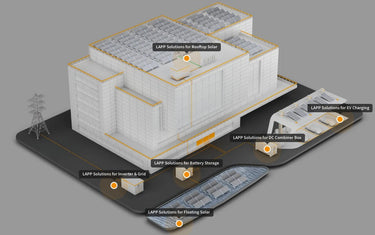
The LAPP Solutions Navigator is a free online tool that shows which LAPP cables and connectors suit each point of a solar or warehouse automation system. You pick an industry, click through the application points in an interactive scene, and download a PDF toolkit made for your company, country and role, with the products for that point and the local LAPP contact. It covers renewable energy and intralogistics today.
It exists because cable selection rarely starts from a catalogue. It starts from a place in a system: the string run on a rooftop, the cable under a floating array, the festoon on a crane, the drag chain behind a robot. Each place has its own failure mode, and a product range organised by part number leaves the engineer to do the matching. The Navigator does that matching by application, with cables AND connectors shown together, because a reliable connection depends on both.
What is the LAPP Solutions Navigator?
It is a visual guide to LAPP connectivity, organised by industry and application rather than by product family. Each industry opens as a scene with active hotspots. Select one and the Navigator shows four things: the reliability challenge at that point, the LAPP cable and the connector, gland or accessory recommended for it, the key ratings, and the technical reason for the choice.
Take floating solar. The challenge it describes is permanent submersion, where hydrostatic pressure and moisture diffusion wear down a cable that was only rated for occasional water contact. The recommendation pairs ÖLFLEX® SOLAR H1 BUR cable, rated AD8 for permanent submersion, with EPIC® SOLAR 4 GEN2 connectors rated IP68, with TÜV Rheinland certification listed. That is the level of detail every hotspot carries.
How does the Navigator work?
Three steps, and the first two take a minute or two.
- Choose your industry. Renewable Energy and Intralogistics are live now.
- Explore the application points. Click a hotspot to see the challenge, the LAPP products for it, the ratings and the reasoning. Renewable Energy has a Commercial & Industrial view and a Residential view.
- Download your toolkit. Enter your work email, company and country, and if you like, your role. For renewable energy you can also add project scale and site environment, and the toolkit adjusts to them.
Which solar and battery storage applications does it cover?
The Commercial & Industrial view covers rooftop solar, floating solar, the DC combiner box, the inverter and grid connection, battery storage and EV charging. The Residential view covers solar panels, mounting structures, the PV inverter, EV charging and home connectivity.
These are the points where tropical sites test a cable hardest: heat on a rooftop, UV on exposed runs, salt mist on coastal and floating plants, humidity inside enclosures. If you want the detail behind those conditions first, our pieces on solar DC cabling in tropical heat and UV-resistant cables for solar and wind in Southeast Asia go deeper on each one.
Which warehouse and intralogistics applications does it cover?
The Warehouse Automation scene covers conveyor systems, cranes and hoists, robotics and stacker cranes. The problems here are mechanical more than environmental: abrasion, continuous bending, torsion and the terminations that work loose under vibration.
At the conveyor, for example, the Navigator describes cables snagging near rollers and the jacket damage and short circuits that follow. It recommends ÖLFLEX® HEAT 180 EWKF, an abrasion and heat resistant cable rated from -60 °C to +180 °C, with SKINTOP® MS-M cable glands sealing up to IP69 and LAPP cable lugs and ferrules to DIN 46228 for the terminations. For moving applications, our guides to robot cable versus drag-chain cable and to connectivity for AMR and AGV fleets add the selection logic behind those choices.
What's in the personalised PDF toolkit?
A short PDF built for your project and ready to share with your team or your client. It opens with a cover carrying your company name, then gives an overview of the application, the cable and connector specifications for it, why LAPP for that industry, and the compliance points and next steps, with your local LAPP contact and QR codes.
The toolkit changes with your answers. A procurement lead and an EPC contractor see different emphasis, and a coastal or high-humidity site brings environment-specific notes. Country selection covers Singapore, Malaysia, Thailand, Vietnam, Indonesia and the Philippines, among others, so the contact on the last page is the team that serves you.
Who is it for?
Design and project engineers specifying a system, procurement teams building a shortlist, and EPC contractors and system integrators who need to show a client what goes where. It is also a fast way to brief a new colleague on why a particular cable or connector belongs at a particular point.
It does not replace a datasheet or an engineering review. The recommendations are a starting point grounded in each application, and the product datasheet stays the source of record for ratings and approvals.
What's coming next?
More industries are being added to the Navigator, starting with data centres. The approach stays the same: start from the application, show the cable and the connector together, and hand you a toolkit you can use.
Frequently asked questions
Is the Solutions Navigator free to use? Yes. Exploring the industries and downloading a toolkit costs nothing. The toolkit form asks for a work email, company and country so the PDF can be personalised and the right local team can follow up.
Which industries does it cover? Renewable energy and intralogistics today. Data centres are next.
Do I need to know the part number first? No. The Navigator starts from the application point, such as a floating array or a conveyor, and shows the LAPP products for it. The part detail follows from there.
Can I share the toolkit with my team or client? Yes. It is a standard PDF made for your company and project, so it can be forwarded, printed or attached to a proposal.
Talk to Our Engineers
Start with the Solutions Navigator and download the toolkit for your application. When a project needs more than the toolkit covers, such as an unusual environment, a long cable run or a mix of moving and fixed installations, bring an engineer in early.
Talk to our connectivity specialists at sales.ph.lph@lapp.com, or through the LAPP SEA enquiry page. LAPP designs and manufactures cables AND connectors, so the cable, the gland and the connector for each point can be specified together in one conversation.


