
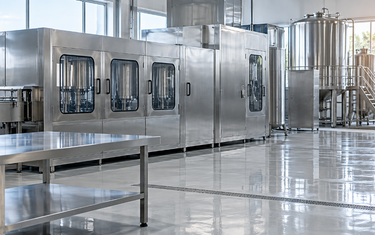
AI-generated industry illustration. No LAPP products depicted.
For a food-production line, washdown suitability is a question about the whole connection: housing, seals, cable entry and cleaning duty. IP69 addresses defined ingress conditions, while chemical compatibility and hygienic design need separate evidence. The assessment therefore belongs to the exact EPIC® connector and SKINTOP® gland variants, not to their family names.
The cable-side decisions are covered in Cable Solutions for the Food and Beverage Industry and Cable Solutions for Food Prep Areas. The connector schedule needs its own assessment of the same cleaning duty, especially where a cable enters a housing or a connection is opened for maintenance.
Why do the connector and gland need as much washdown scrutiny as the cable?
Position matters. A connector directly in the spray path may face a different cleaning duty from one protected inside a cabinet on the same machine. Map those exposures before assigning requirements, so the specification describes the connection's actual location rather than a general label for the room.
At the installed joint, look for places where residue could collect or access for cleaning is restricted. The mating face and cable entry deserve attention alongside the housing profile, since material incompatibility, corrosion or damaged sealing surfaces can affect the connection even when the cable itself was selected correctly.
What happens when the connection is opened? Its normal mated condition may not describe what it faces during cleaning or maintenance, so the plant team needs to identify the protection and release procedures for that situation. Returning a replacement to production should follow those procedures, not an assumption made in the parts order.
Give the connector and gland selectors the same cleaning specification: agent, concentration, exposure time and temperature, together with the wash method and frequency. If that information changes during commissioning, the material selection may need another look. The original choice was made for the original duty.
What does IP69 actually mean for a food and beverage connector?
IP69 is an ingress protection classification defined by EN 60529, with the water-protection component addressing high-pressure, high-temperature jets under defined test conditions. Read the stated rating alongside the assembly requirements for the exact product. Establish whether those conditions address the intended duty rather than treating IP69 as a universal requirement for every washdown location.
Chemical resistance is a different question. A rating for water ingress does not establish resistance to the plant's caustic or acidic cleaner, and neither establishes that the assembled connection is hygienically designed.
The installation conditions matter just as much as the rating on the page. Mating condition, cable entry and required accessories can be part of that specification; an open connector or a different sealing arrangement cannot simply inherit the original enclosure rating.
The SKINTOP® HYGIENIC SC NPT datasheet provides a specific example. It lists IP69 according to EN 60529 and identifies hygienic design separately, with an invitation to contact the laboratory about resistance to aggressive agents and special oils.
The named gland is the scope of that evidence. An EPIC® connector fitted alongside it needs its own supporting information, as does any other SKINTOP® variant under consideration. The gland datasheet helps with selection, but it cannot answer an undocumented connector requirement.
How do hygienic design and housing material change the connector spec?
A smooth housing is not the whole answer if its seal material is unsuitable for the cleaner. Equally, chemically suitable material does not remove a sheltered joint created by the mounting arrangement. Cleanability and compatibility need evidence of their own.
Consider the component as it will be installed, with its fasteners, mounting surface and gland in place. Can the cleaning process reach the relevant surfaces? Where hygienic certification is required, its scope and installation conditions should cover the exact product rather than merely a related family.
Check the materials of the housing and seals against the actual cleaner and exposure conditions. The SKINTOP® HYGIENIC SC NPT datasheet, for example, identifies stainless steel for the gland body and cap nut and a special elastomer for its seals, which shows why the housing material alone is not a complete compatibility statement.
Published compatibility information may not cover the particular mixture or cleaning cycle used by the plant. In that case, send the cleaning specification for confirmation and keep the response with the part reference, giving any later change of cleaner or exposure conditions a clear starting point for reassessment.
The cable-entry gland also has to match the cable and mounting arrangement. Check the chosen variant’s clamping range, sealing surfaces and assembly instructions in its datasheet; the SKINTOP® and IP-rated enclosures guide provides the cable-entry context.
For a replacement, the maintenance team needs the approved connector, gland, cable and accessory references together, including cleaning restrictions. That distinguishes a documented alternative from a spare that only looks similar; the EPIC® industrial connector comparison provides family context, while the selected variant still needs to suit the application.
Cable jacket selection and cable food-contact requirements are covered in the companion articles. Clean-in-place and steam-in-place process piping requires its own process-engineering assessment and is outside this connector schedule.
For an existing installation, photograph the connection and mark its position on the equipment drawing, keeping observations about the old part separate from requirements for the replacement. Operating without a visible leak does not, by itself, document suitability for a new cleaning regime.
A maintenance handover should state how protection is maintained when a connection is open and name any required cover, mating condition or other documented measure.
File the cleaning specification with the component references, relevant datasheets and application-specific confirmation for that interface. When the cleaning process changes, the affected selections can be reviewed together, and purchasing has a basis for rejecting substitutes that match only the dimensions or IP class while leaving material and cleanability unanswered.
Talk to Our Engineers
For a new line, start the enquiry with the cleaning specification and equipment drawing. For a retrofit, include the existing connection and the reason it is being replaced. Talk to our hygienic connectivity specialists about those details so the selected EPIC® connector and SKINTOP® gland can be assessed for the intended installation.
LAPP engineers and produces cables and connectors. That gives the discussion scope to include the cable entry and mating interface together, including whether the connection opens during cleaning or maintenance and which product approvals the installation requires.
Use the LAPP SEA enquiry page to share those requirements, or visit the food and beverage industry page for application context. Confirm the chosen components against the intended cleaning regime before releasing the final connectivity schedule.


